
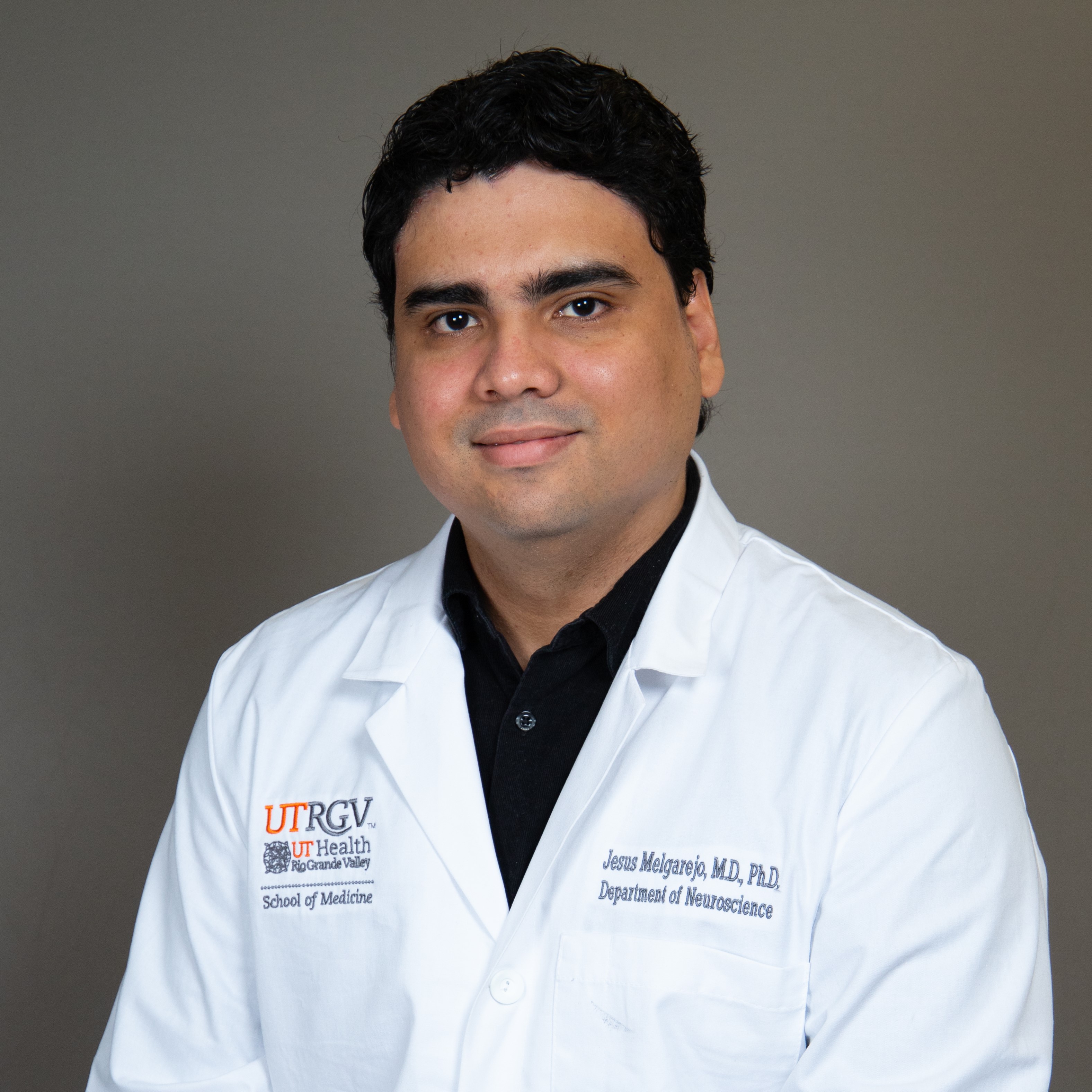
Name: Jesus David Melgarejo Arias
Affiliation: Institute of Neuroscience, University of Texas Rio Grande Valley, Texas, USA
Linkedin: https://www.linkedin.com/in/jesus-d-melgarejo-arias-382a2b172/
https://www.linkedin.com/showcase/utrgvsom/posts/?feedView=all
X: https://x.com/utrgvsom
FB: https://www.facebook.com/UTRGVSOM/
Instagram: https://www.instagram.com/utrgvsom/?hl=en
Tell us about yourself.
I am Jesus David Melgarejo Arias, a physician-scientist working on blood pressure. I was born and raised in Maracaibo, Venezuela, where I also studied medicine. I have been involved in science since I was 17, before I started medical school. I travelled to the other side of the world, where I completed my PhD in cardiovascular science at KU Leuven, Belgium. Today, I have been an assistant professor of Neuroscience at the University of Texas Rio Grande Valley for over 3 years.
What are your research interests?
My research interests include neuroscience and cardiovascular science. Specifically, I focus on 24-hour ambulatory blood pressure monitoring. This has allowed me to study blood pressure not only as an average value, but also as a dynamic biological signal that reflects how the vascular system is regulated over a 24-hour period.
The diseases that I am most interested in investigating include glaucoma, cerebral small vessel disease, Alzheimer's disease, and cardiovascular outcomes. My background is in population-based studies; however, I have also had the opportunity to evaluate clinical cohorts since my PhD training. At our center in UTRGV, I continue evaluating clinical participants from our South Texas Alzheimer’s Center while developing a research program to elucidate mechanisms of vascular dysregulation in aging and disease. These efforts aim to identify early vascular markers that may inform prevention and risk stratification across neurological and cardiovascular conditions.
What are you working on right now?
Currently, I am working on a hypertension research project and examining how blood pressure variability has traditionally been measured using metrics such as standard deviation and the average absolute variability index. These approaches capture what is known as linear variability. However, biological systems, such as the cardiovascular system, are dynamic and operate nonlinearly.
By analysing 24-hour blood pressure data as a time series, we have been able to quantify the degree of regulation and stationary patterns using nonlinear dynamics that are not captured by conventional metrics of linear variability.
In our most recent research, we are applying metrics of nonlinear dynamics – such as entropy and fractal dimension – to characterize these patterns in 24-hour blood pressure data. By conducting extensive population-based studies in Venezuela, Spain, and Japan, we are finding that nonlinear blood pressure dynamics are more irregular and chaotic. These are reflected by higher entropy and lower fractal dimension, which are associated with cognitive impairment and a higher baseline odds of dementia.
Based on these findings, we believe this opens new opportunities to use 24-hour blood pressure monitoring not only to understand dementia better, but also to gain broader insights into vascular regulation in aging and disease. This is just the first step toward many more projects, which is very exciting.
What do you hope to achieve in the field of hypertension over the next 5 years?
My hope is that evidence continues to show the relevance of controlling blood pressure to prevent cognitive decline, slow progression, and reduce the risk of dementia. In addition to controlling hypertension, I hope to be able to continue focusing on showing the relevance of considering blood pressure dysregulation. Over the next five years, I aim to help shift how we understand hypertension - from a condition defined primarily by average blood pressure levels to one that also reflects blood pressure dysregulation. My goal is to study 24-hour blood pressure dynamics as a meaningful dimension of vascular health, particularly in relation to brain aging and dementia.
I aim to develop and validate metrics of blood pressure regulation that capture nonlinear dynamics and vascular dysregulation, and to integrate these measures with neuroimaging, retinal microvascular imaging, and blood-based biomarkers of Alzheimer's disease and related disorders. By doing so, I hope to identify early vascular signatures of cognitive decline that can be detected before irreversible brain damage occurs.
Ultimately, my objective is to translate these insights into more precise risk stratification and prevention strategies, helping clinicians move beyond single blood pressure readings toward a more dynamic, personalized understanding of hypertension and its impact on aging and disease. And with the growing advances in technology, I believe that a better understanding of blood pressure dynamics is vital to exploit the high-dimensional data that new devices will capture fully.
What challenges have you faced in your career to date?.
This is a difficult question. During my medical training, my home country, Venezuela, was experiencing the worst political and societal instability that we have had over two decades. At the time, access to basic resources was extremely limited – we faced shortages of electricity, transportation, water, and food, and I basically had no internet.
Coming from a low socioeconomic background added to these challenges. Living through that period profoundly shaped my perspective; it taught me resilience and a unique sense of purpose. After those experiences, most professional challenges feel manageable, and I believe every challenge is also a learning opportunity that strengthens us and shapes how we move forward.
Finally, since beginning my PhD training, my greatest ongoing challenge has been the distance from my family. We communicate every day, they are well, but I wish they could come here and be closer. While that distance is difficult, it has also reinforced my sense of purpose and commitment to building a meaningful scientific
and medical career.
Which of your publications are you proudest of and why?
I am still proudest of my first scientific publication. That paper represented several significant milestones for me. Scientifically, it introduced me to 24-hour ambulatory blood pressure monitoring, which remains one of my central research interests today.
Personally, it was conducted during a challenging period in my home country, and it reminded me of the broader social and structural contexts in which research often takes place. Most importantly, that work connected me with an extraordinary group of scientists who later became my mentors and collaborators – and with whom I continue to work closely. In that sense, that publication did not just shape my research direction; it also shaped my scientific community and career.
What is your favourite manuscript from a lab other than your own?
Surprisingly, I do not have a single favourite paper. Instead, I find comprehensive systematic reviews particularly valuable – especially those focused on blood pressure variability, glaucoma, circadian rhythms, coronary artery disease, arterial stiffness, and cerebral small vessel disease. I return to these reviews often because they help me think through my research questions.
What are your passions outside of work?
My passion outside of work is music. I am a musician, and this is a passion that has dramatically influenced my personal life, but I also feel it shapes how I do science.
I listen to different kinds of music, primarily blues, rock, and metal. I play both classical and electric guitar. Music gives my scientific work a creative balance.